
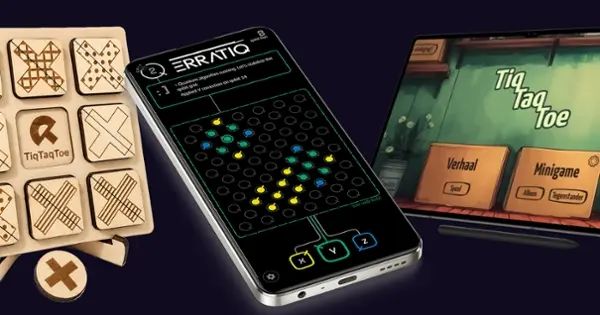
The Centre for Quantum and Society (CQS) is proud to support HAIQ (Human- and Artificial-Intelligence advancing Quantum Technology), the consortium led by Leiden researchers Evert van Nieuwenburg and Julia Cramer, which has been awarded a €7.5 million NWA-ORC grant. HAIQ sets out to involve society in the development of quantum technology, using games and artificial intelligence as the bridge between scientists, the public and technology.
Experts, the public and AI around one table
HAIQ brings together three very different groups: experts, members of the public and AI. On the online HAIQ platform, they will work side by side on real quantum challenges and explore how those challenges connect to everyday life and society. Gamification is the common language that links them.
The consortium is deliberately broad. Alongside physicists and AI specialists, it includes linguists, philosophers, industrial designers and game designers, as well as partners from vocational colleges (MBO), universities of applied sciences and research universities. Impact assessments built into the project will allow the team to adjust course as it goes, with the aim of creating a genuine two-way dialogue between experts and non-experts.
“This project deliberately brings together a wide range of disciplines and organisations,” says Julia Cramer, who researches the interaction between quantum technology and society.
The CQS contribution: the Inqubator
CQS specifically supports the work of the Inqubator. The Inqubator turns promising ideas from HAIQ’s co-design sessions into more professional game prototypes. The funding covers the work of game developers beyond the co-design sessions themselves, and can also provide small stipends for groups of students at the participating institutions, giving the next generation of makers a direct role in shaping how quantum technology is understood.
Why games?
Quantum games make the invisible visible, the complex playful and the exclusive inclusive. Players don’t read about superposition or entanglement in a formula; they see the effects through play. Because games ask for participation rather than passive attention, they spark curiosity, help people retain complex ideas and invite them to keep exploring.
Games also work as “boundary objects”: shared spaces where children, students, the general public and policymakers can discuss the same issue from their own perspectives. At a time of scientific scepticism, they offer a way to build trust by fostering understanding rather than relying on authority, by showing real-world use cases such as quantum sensing in health, climate or communication, and by letting people co-own the creation of knowledge.
Building on our Quantum & Games work
HAIQ builds on CQS’s ongoing Quantum & Games project. In 2025, CQS supported EduQuation in offering quantum game packages to schools and organisations, and QuantumPlayed, founded by Evert van Nieuwenburg, in developing digital and physical quantum games. That work includes TiqTaqToe, the BitFlip and Networq card games, quantum game jams with the Dutch Games Association and the Qaggle platform, a crowdsourced hub for quantum challenges. Our contribution to HAIQ is the next step in scaling and professionalising quantum games as a way to engage society.
Read more information on the original article, in the following link: https://www.universiteitleiden.nl/en/news/2026/11/creative-games-provide-solutions-in-complex-quantum-research





Leave A Comment